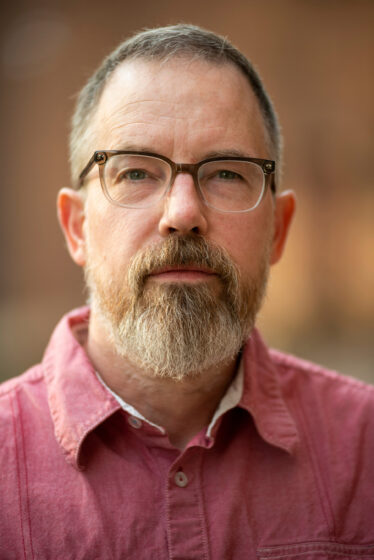
Headshot taken by Dan Marshall. All other photographs in this article were taken and provided by Todd Thyberg.
TODD THYBERG of Angel Bomb comes to us from Minneapolis, Minnesota. As a regular customer of Boxcar Press for the past 20 years, Todd’s focus has shifted to his impressive handmade books, pressed with our photopolymer plates. They are featured in over 100 private collections, libraries, and universities. Utilizing the world around him, Todd draws inspiration from all over, from the the town in which he prints to his voyages all the way down to Antarctica. We invited Todd to share his story with us.
SMALL BEGINNINGS, BIG CITY — I come from a small town in North Dakota and moved to Minneapolis in my 20s to attend the University of Minnesota, where I majored in graphic design along with taking creative writing classes. I’ve made Minneapolis my home because it has such a supportive arts community. I love living in a city that’s big enough to offer a wide array of diverse cultural activities without being too large and chaotic.
I founded Angel Bomb in 1997 as a graphic design studio. I added letterpress capabilities in 2006, and have evolved my business from producing client work to creating fine arts books full-time. My work spans social justice topics, science fiction, experiential reads, and horror, etc.
Whenever I start a new book project, I fully immerse myself in the subject matter. For example, in order to gain first-hand experience and knowledge about climate change’s devastating effects on the polar ice caps, I took on the persona of a polar explorer from days of yore. I’ve sailed on board tall ships in both polar regions, with my most recent adventure sailing from Argentina to Antarctica – crossing the treacherous Drake Passage en route – for book research. When I seek out challenges like these, it’s how a lot of my book ideas flow.
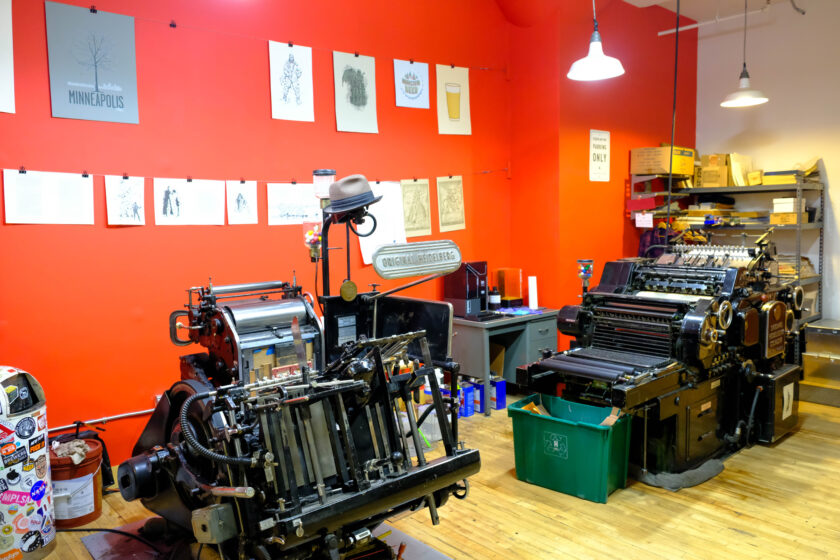
SMALL PRESS, BIG IMPACT — As a graphic designer, I’ve always loved letterpress and was drawn to the handcrafted, tactile nature of it. Luckily, there was a lot of it happening in Minneapolis. Little did I know you could buy a press, learn how to use it, and put it to work.
I received a tiny Kelsey tabletop press as a gift and it was too small to be anything more than a novelty, so I found a larger Chandler and Price on Ebay and drove to Indianapolis to pick it up. Then I hired some local letterpress printers to educate me. (Shout out to Allison Price and Monica Edwards Larson for my initial tutelage!)
I printed for myself until I felt confident enough to offer it to my clients at Angel Bomb. Within a few years I was printing more than I was designing and thoroughly enjoyed the physicality of it, especially being able to bring my designs to fruition from concept to printed piece.
Seeing one of my designs – or one that a client had brought to me – come to life on press through color and impression is deeply satisfying. At the end of a print run, here you have a stack of beautiful work that will go out into the world and get passed from person to person, hopefully with a little awe or delight on the recipient’s part. That’s a wonderful thing to think about.
What was your very first press? The silly Kelsey 3×5″. Just a toy, really. I used it once to print my name and then bought the 8×10″ Chandler and Price.
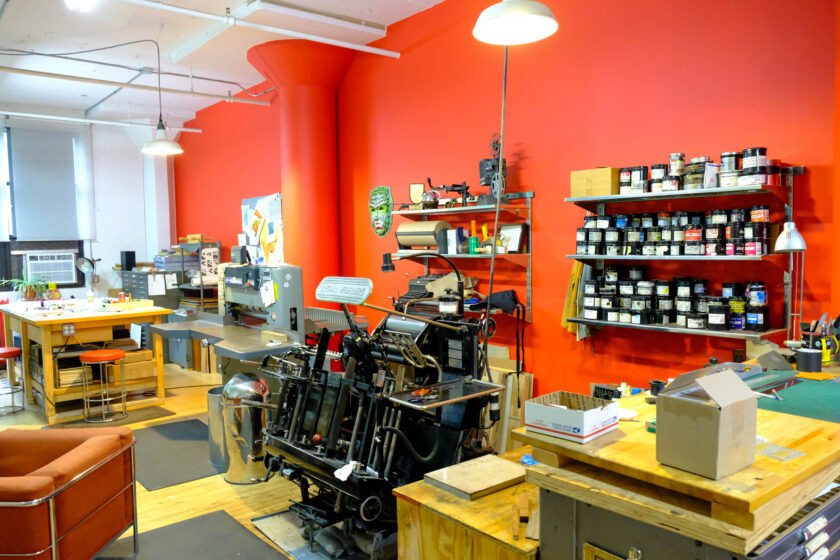
For years I was always looking for presses that would print larger, faster, better, etc. so I’ve had nine presses over the years: C&Ps, Miehles, Vandercooks, and Heidelbergs. Once I became proficient on my first Windmill, I was sold on Heidelbergs and the ease of registration and consistency with them. I love being able to print and diecut, and now I have a Windmill dedicated to each purpose.
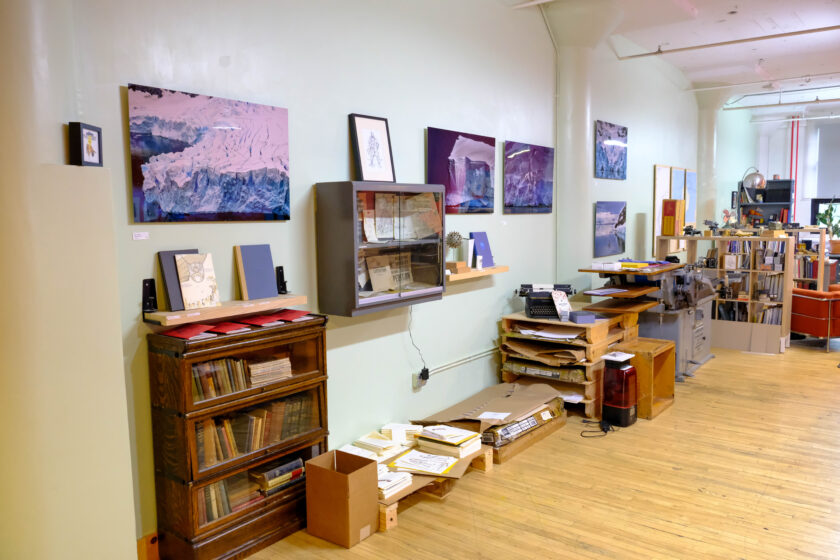
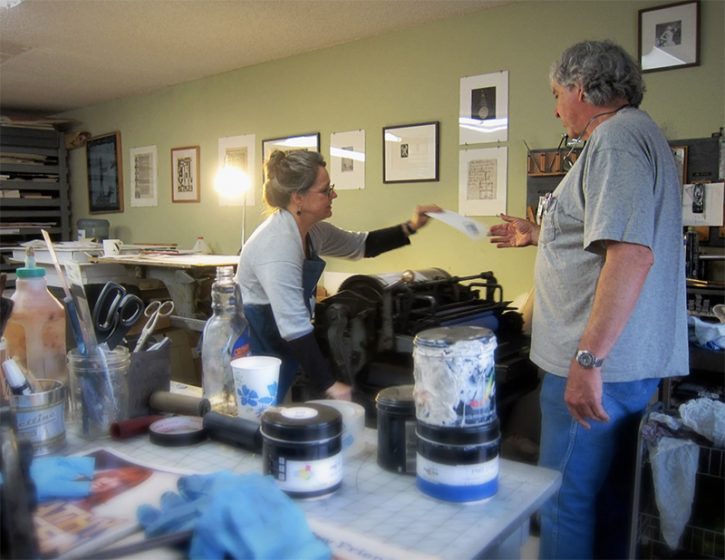
COMFORT & COMMUNITY — Angel Bomb has changed a lot over the years but my studio remains a creative and inspiring place. I like to keep it comfortable and cozy, and I change the layout periodically to reinvigorate the space. Could be a fresh coat of paint on the walls, a reading nook bordered by bookshelves, or rearranging what’s on display.
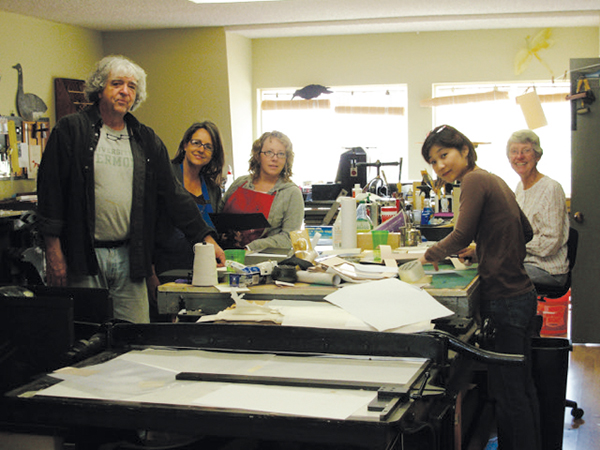
I’m located in a large building full of artists, which is great because I mostly work by myself so it’s nice to have people around. We’re a pretty good community when it comes to helping each other out. I love helping other artists by cutting their paper down or lending them a tool, and if I need some woodwork or metalwork done I know someone who can help.
What’s nearby? My studio is in the Northrup King Building, a 109 year-old former seed processing plant in the center of Minneapolis’ Arts District. I’ve been here for 20 years and it’s a cool historic building with lots of weird, hidden spots that people aren’t supposed to wander around in. I’ve actually filmed a couple of spooky introduction videos for some of my books here – with permission, of course – and the setting was perfect.
The local restaurant and craft beer scene in Northeast Minneapolis, where the Arts District is located, is fantastic and well known throughout the metro. Lots of great options can be found in the smaller neighborhoods throughout “Nordeast,” which makes it easy to entertain guests from out of town. There are several restaurants that’ve made the New York Times’ best in the country lists in recent years such as Oro by Nixta, Vinai, and Diane’s Place. My all-time favorite and somewhere I eat regularly is a local Mexican restaurant called Maya. Highly recommend.
And of course, being in a city with a Book Arts Center is tremendous. I’m so glad that the Minnesota Center for Book Arts (MCBA) and the community they promote is here. Without it, I don’t think I could have successfully traversed this path that I’m on.
MENTORS & SHOUT-OUTS — I’m big fans of Allison and Monica and another local, Kent Aldrich, who runs Nomadic Press. Most letterpress people in the Twin Cities have been willing to help out and be a good neighbor, which is great if you’re in a jam. I’ve enjoyed doing the same for others.

FULL-TIME BOOK-BIND — Once I added letterpress to Angel Bomb, I loved it and had a great run up until COVID. I would make plates and print most days of the week. I’d print a book every other year and worked with hundreds of clients printing business cards, wedding and event invitations, coasters, and brand packaging. The tactile nature of letterpress and the use of quality paper is important to me.
When the pandemic slowed everything down, I decided to focus on my book arts. I still take care of existing clients and welcome new ones who share the same values, but I’m much less of a job shop now and instead put my energy into my book projects. Books take quite some time to design and produce, so I’m not on press as much as I’d like.
OPEN MIND AND FINE DESIGN — Oh yes, that’s what I trained for! I’ve always been a fan of working with words, so my design processes usually start with free association. What does this project want to be, how should it be received, what should it look and feel like? I always strive to create something that people want to hold onto, to pin up on their bulletin board because it’s cool or unique. This all starts with language and from that, I start to sketch and determine how best to visually represent the ideas I’ve jotted down to turn words into effective visual designs.
I like to look at historical references for inspiration. My design has always been bold and graphic, so early 20th-century propaganda and art from the Works Progress Administration (WPA) are right up my alley. This was a time when artists were hired for commercial work, and it really shows in advertisements that burst with beauty and dynamism that still hold up even today.
ASTOUNDING ACCOMPLISHMENTS — Back in 2012 I received my first grant, a Jerome Book Arts grant through the MN Center for Book Arts. I was thoroughly excited! Here was an organization that felt the idea I had for my first book was worth supporting with an exhibition and financial backing. It was an amazing experience and so affirming. The result of this grant was The Airship.
My second book was also supported through a grant from the State Arts Board two years later and that showed me that I was on to something. I didn’t get a lot of support when pursuing my artistic potential growing up so getting grants from organizations and recognition for my work really validated that I was heading in the right direction.
I continued making books and in 2023 won a McKnight Book Arts Fellowship, which literally brought tears to my eyes. I’ve long sought recognition and affirmation of my book art and am extremely proud of achieving this milestone. McKnight made it possible for me to travel to Antarctica and further my education at book arts institutions.
Lastly, my work appears in over 100 private, library, and university special collections and museums across the U.S. and Canada. I’ve been fortunate to foster meaningful connections with people I’ve met at places like the annual Manhattan Book Fair and biannual Necronomicon in Providence, RI, which has led to multiple purchases from my book art catalogue.
HISTORY WITH BOXCAR — I’ve been working with Boxcar since I started printing, so for 20 years! I did have my own platemaker when I was printing a lot, but Boxcar still helped with troubleshooting and negatives. Since I sold the platemaker, I now order my photopolymer plates from Boxcar and know that they’ll be properly exposed and shipped straight to me in a timely manner.
A TIP FROM AN ANGEL — One trick I learned from a pressman I’d used years ago – an old guy with only one good eye – was to push the job towards the top of the page to allow the crop marks to run slightly off the top of the page. This is useful to be able to see any shifting in the print from subtle differences in feeding. It’s a great help with registering the opposite side too, allowing you to see both impressions and adjust the guide to pull them together.
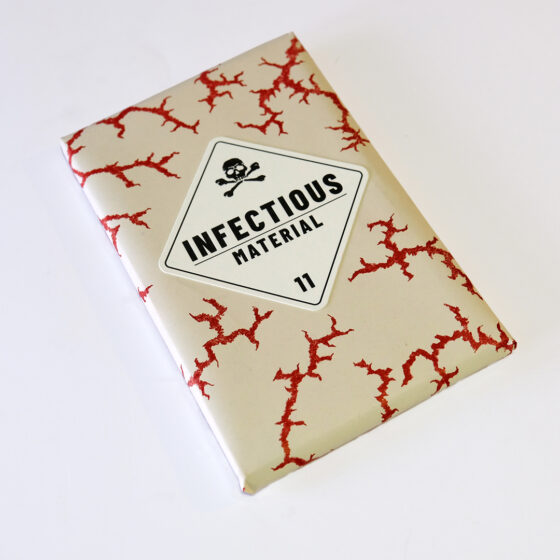
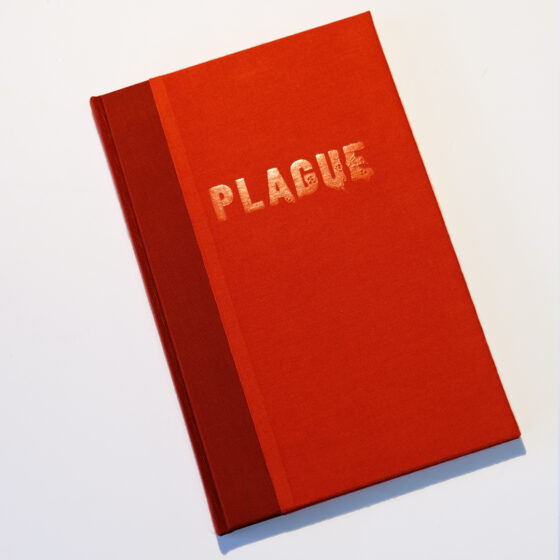
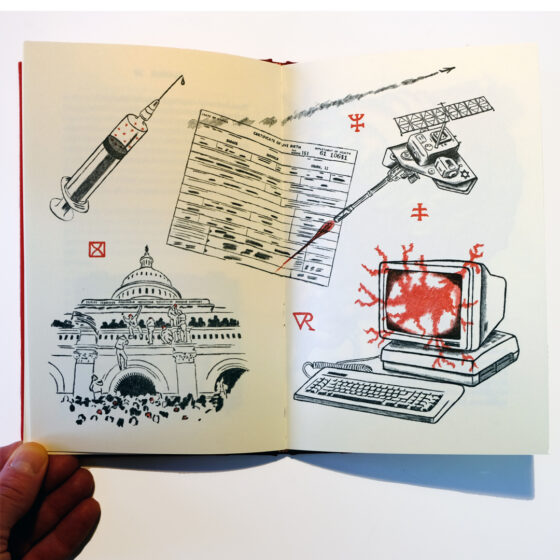
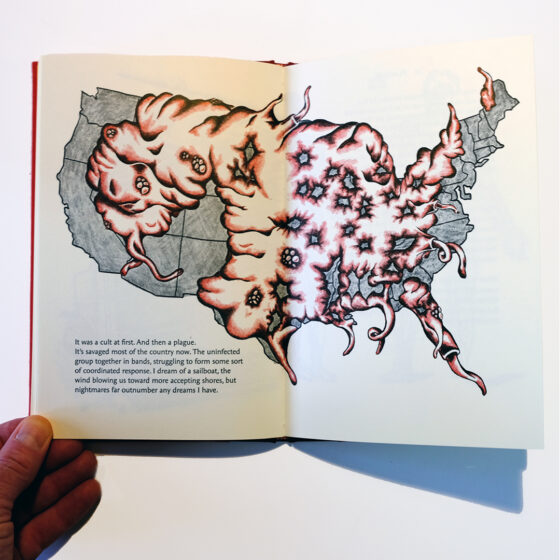
WHAT THE FUTURE HOLDS — I just finished a difficult book, Plague, and am now trying to work on something a little lighter and less stressful. Plague is a story I started last year when the current administration weaponized their assault against immigrant and LGBTQ+ communities. I was profoundly offended and angered that I needed to manifest something from these feelings.
Plague is a timely zombie-apocalypse story using political allegory to examine the rise of extremism in contemporary America. The narrator and his small band of survivors, including a gay couple targeted for who they are, hide from the violent “infected” horde who have succumbed to a plague of fear-mongering, propaganda, and rage.
It’s the most personal work I’ve created, and I feel the voice of the narrator is my own. The “hunted” in the story are characters based on my close friends.
When ICE came to Minneapolis and murdered Renee Good and Alex Pretti, real life outpaced my fiction, and I felt a strong need to record what was going on in my art and put it out there.
WHAT NEXT – Sooooo… right now I’m illustrating an edition of The Raven by Edgar Allen Poe, which will have a unique twist to it, and I’m also working on books based on my voyage to Antarctica.
A big thank you to Todd for sharing his book and print passion. We look forward to seeing what cool new opportunities come his way.